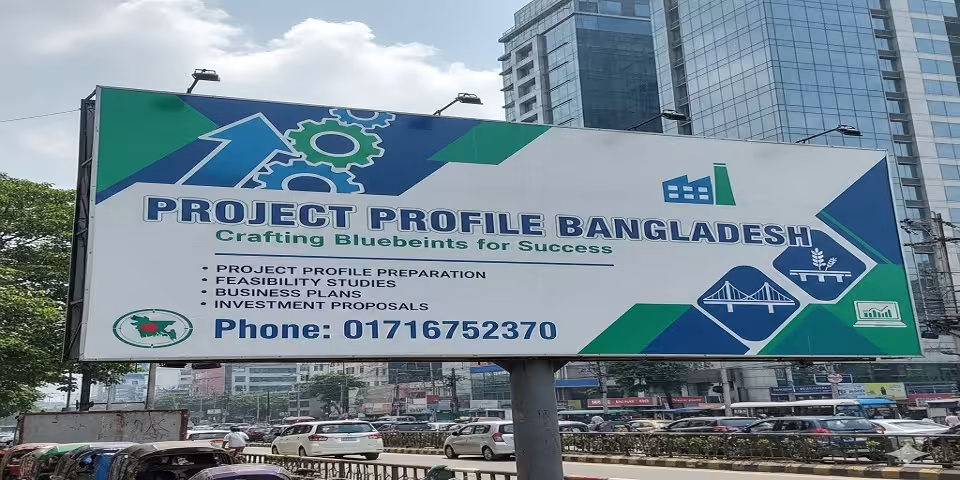
Project Profile and Feasibility Study of GreenCycle Poly-Waste Solutions
Pioneering the Circular Economy in the Post-LDC Era
Sustainable waste management is the most effective way to decouple industrial growth from expensive raw material imports. While Bangladesh’s economy faces a projected growth slowdown to 3.9% in FY26, the demand for recycled materials remains resilient due to global “Green Procurement” mandates. Therefore, Project Profile Bangladesh (PPB) architects project profiles that focus on high-purity mechanical recycling. Because the 2026 industrial landscape prioritizes “Green Transformation,” we help you capture low-interest refinancing from the central bank’s specialized sustainability windows. Rather than seeing discarded plastic as a liability, we help you treat it as a domestic goldmine that reduces your reliance on volatile foreign exchange reserves. While the macro-economy is tightening, the circular economy is expanding.
The 2026 Recycling Landscape: Market Gaps and Policy Drivers
The convergence of the 2026 ‘Integrated Plastic Management Policy’ and LDC graduation has created a mandatory shift toward recycling. While traditional manufacturing faces rising energy costs, recycling units benefit from the 2026 “Clean Tech” tax holidays and reduced import duties on specialized sorting machinery. Therefore, our feasibility studies highlight the strategic advantage of “Black Mass” processing and rPET production to satisfy the EU’s upcoming carbon border adjustments. Because the domestic FMCG sector is under pressure to use 30% recycled content by 2027, the internal market for high-quality pellets is guaranteed. Rather than competing with imported virgin resins, you will be the primary source for compliant, locally-sourced materials. While the national poverty rate has seen a slight uptick to 21.4%, the recycling sector provides a massive opportunity for decentralized job creation.
| Sector Metric (2026) | Recycling Industry Status | PPB Implementation Focus |
|---|---|---|
| National Growth | 3.9% (Projected FY26) | Counter-Cyclical Growth via Waste |
| Inflation Hedge | 8.5% (High Currency Volatility) | Replacing Imports with Local rPET |
| Policy Incentive | Green Transformation Fund (GTF) | 5% Refinance for Wash Lines |
| Compliance | EU GSP+ & Carbon Reporting | Traceable, Ethical Supply Chains |
| Market Gap | 70% of Waste Unrecovered | High-Volume Industrial Collection |
Technical Mastery in Automated Sorting and Extrusion
The profitability of a recycling plant depends entirely on the purity of the final output. While manual sorting was once the norm, the 2026 market demands optical sorters and hot-wash systems that remove 99.9% of contaminants. Therefore, PPB integrates German-standard extrusion technology and automated filtration into your technical roadmap. Because energy reliability is a concern, we recommend integrating 100kW+ rooftop solar arrays to power the washing and drying cycles. Rather than a basic “crushing” unit, we design a facility that produces uniform, food-grade pellets ready for the global market. While the machinery is a significant investment, the ability to sell at premium “Compliance Prices” ensures a rapid ROI.
Financial Engineering for the Green Transformation Fund (GTF)
Securing a loan in the current high-interest environment requires a document that satisfies ‘Green Finance’ criteria. While general commercial lending rates are elevated due to a stressed banking sector, the GTF offers a rare window for refinancing at only 5% interest. Therefore, PPB structures your financial proposal to maximize these concessional funds for your eco-friendly capital machinery. Because we understand the current fiscal pressures, we provide a 5-year cash flow analysis that accounts for the 8.5% inflation rate and currency fluctuations. Rather than a generic budget, we provide a “Price Sensitivity Matrix” that proves your project’s resilience against rising utility costs. While the bank seeks to minimize risk in a fragile sector, we provide the industrial logic that proves your project is a priority for the national “Green Transition.”
Navigating Global Compliance and Export Standards
As Bangladesh graduates from LDC status, the recycling sector is your ticket to maintaining duty-free access. While traditional exports face new barriers, “Sustainable” and “Recycled” products are receiving preferential treatment under the new UK DCTS and EU GSP+ regimes. Therefore, our project profiles prioritize GRS (Global Recycled Standard) certification and supply chain transparency. Because international buyers are moving away from linear “Take-Make-Waste” models, we help you build a facility that acts as a certified partner for global RMG and footwear brands. Rather than fearing the end of duty-free access, we help you transition to a model where your environmental credentials are your strongest selling point. While the rules of trade are changing, a “Zero-Waste” certificate is a universal passport.
Secure Your Industrial Future with PPB
The transition to a circular economy is the single most important strategy for industrial resilience in 2026. While the vision to clean the environment and build a profitable business is yours, the technical and financial architecture belongs to Project Profile Bangladesh. Therefore, do not risk your capital on a basic report when the 2026 landscape requires high-compliance, bankable blueprints. Because we have mastered the nuances of the latest “Green Refinance” schemes and post-LDC trade rules, we know exactly how to secure your approvals and funding. Rather than being a spectator to the digital and green revolution, become the leader who powers it. While the economy faces challenges, your project will be part of the solution.
- Office: Project Profile Bangladesh (PPB)
- Specialty: rPET Production, Industrial Waste Management, & GTF Financing
- Services: Bankable Profiles, GRS Compliance, & PLC-Automated Layouts
- Action: Consult our 2026 Circular Economy experts to launch your GreenCycle facility